
Every enterprise technology vendor has an AI story now. Most of those stories end the same way: replace your current stack with ours.
That pitch doesn't land with enterprise buyers — and for good reason.
The Replacement Fallacy
Large enterprises run on complex, interconnected systems that took years to implement. SAP, Dynamics, Oracle, homegrown applications, SharePoint sites that have become accidental databases, Excel files that are the actual system of record.
These systems aren't going anywhere. They work — imperfectly, but they work. And the true cost of replacing them goes far beyond the software licence. It's the migration risk, the retraining, the business disruption, and the political capital required to push it through. Most organisations that attempt a full rip-and-replace either stall midway or end up with a system that's different but not better.
Meanwhile, the operational problems that AI could actually solve — manual data entry, broken reconciliation workflows, compliance gaps — keep waiting.
The Intelligence Layer
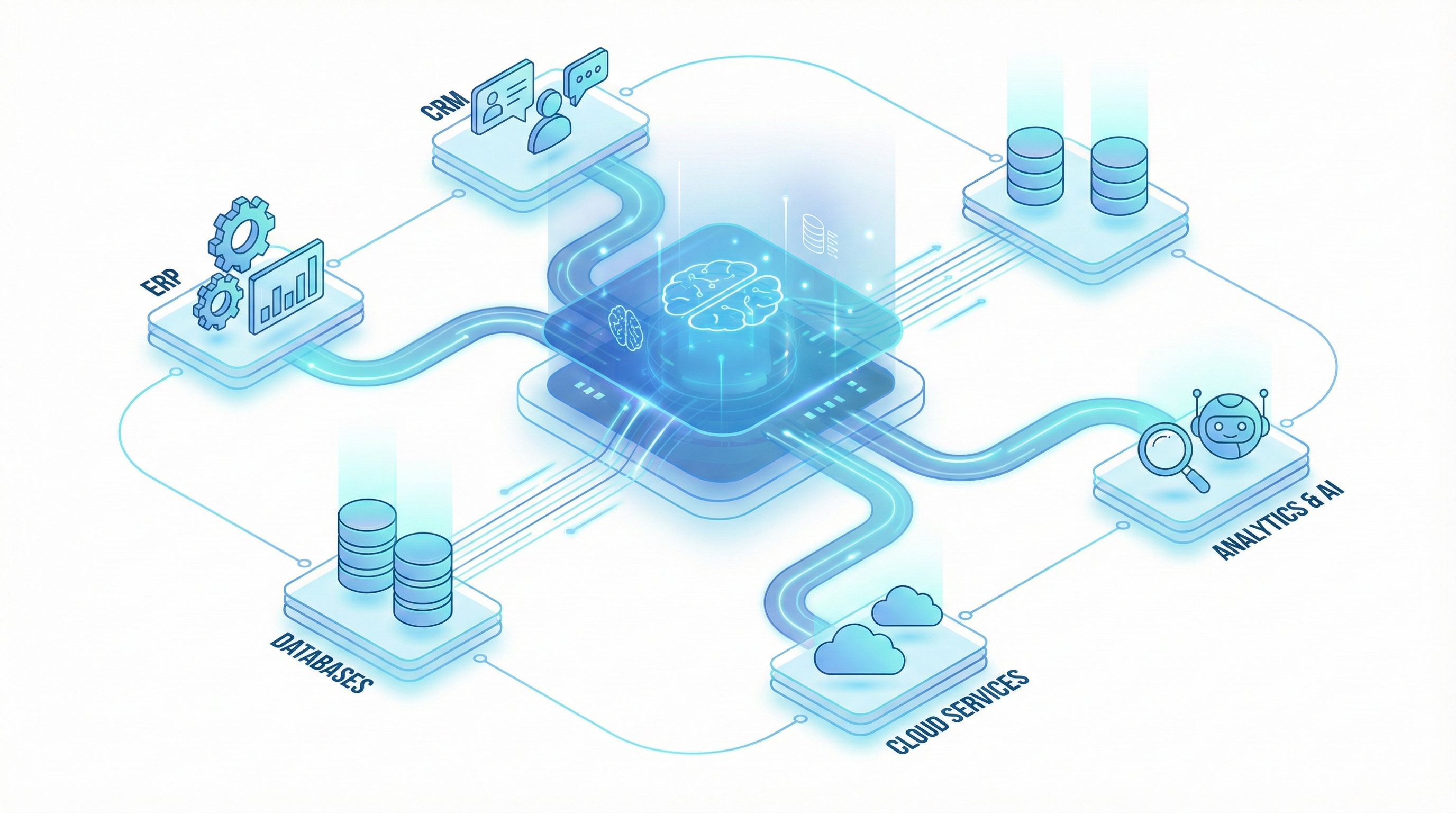
What most enterprises actually need isn't a new system. It's an intelligent layer that sits above their existing stack and makes it work better.
The concept is simple: your systems stay in place, but the manual connective tissue between them becomes automated. Right now, people are the integration layer. They move data between systems, check for consistency, chase approvals, and manually reconcile records across platforms. That's not a technology problem. It's a workflow problem — and it's solvable without touching the underlying systems.
When an intelligence layer works, documents get extracted and validated against ERP data automatically. Approvals route based on business rules instead of email chains. Reconciliation happens continuously, not as a monthly fire drill. And every step is logged for audit without anyone having to remember to do it.
The same SAP instance, the same Oracle environment, the same SharePoint libraries — but with dramatically less manual work holding them together.
Why This Matters Now
This isn't a theoretical concept. Three shifts have made it practical.
AI document understanding is production-ready. Modern extraction handles invoices, statements, contracts, and trade documents at enterprise-grade accuracy. API-first architecture is now the norm, which means connecting existing systems no longer requires the custom middleware nightmares of a decade ago. And finance leaders have stopped funding "innovation projects" with vague benefits — they want measurable ROI, fast.
The convergence of these factors means enterprises can get real value from AI in weeks, not years — without the organisational trauma of a system overhaul.
The Takeaway
Enterprise AI doesn't require a technology revolution. It requires connecting what you already have and making it intelligent.
The enterprises that move fastest aren't the ones buying new platforms. They're the ones layering intelligence onto their existing operations — and seeing measurable results before the first renewal cycle.
If you're weighing a major system replacement to solve operational problems, there may be a faster path. Let's explore it.
See This Approach in Action
- Japanese Precision Manufacturer DX — Instead of consolidating 4 regional SAP instances, an intelligence layer across all of them delivered value in 3 months at a fraction of the cost.
- APAC Consumer Goods Trade Operations — After an 18-month ERP upgrade failed to fix operational bottlenecks, the intelligence layer approach delivered measurable improvement in weeks.
- Singapore Financial Services KYC — Automated document verification and compliance workflows layered on top of existing systems — without replacing a single platform.
Related Reading
- Japan's DX Revolution — How Japan's Digital Transformation initiative is proving that intelligence layers outperform system replacement.
- Why Most Invoice Automation Projects Fail — The workflow-first approach that makes automation actually work.
- Explore our solutions — The capabilities we deploy on top of existing enterprise systems.